The HRIS Selection Playbook: How Modern Organizations Choose the Right System, and Set Up for Success

Why the next system you choose will shape your workforce, your operations, and your future agility.
Selecting a new HRIS used to be a technical upgrade. Today, it’s an enterprise-defining decision. HR leaders aren’t just choosing a system anymore; they’re choosing an operational backbone. A platform that determines how employees experience work, how managers make decisions, how quickly HR can respond to strategy, and how the business scales.
It’s one of the highest-impact investments a CHRO, CFO, or PeopleOps leader will make in a decade. Yet most organizations still treat HRIS selection like a “feature comparison” exercise. And that’s exactly why implementations struggle, costs balloon, and adoption falls flat.
This guide takes you through a modern, business-first, founder-led perspective on HRIS selection of what matters, what doesn’t, and how organizations can prepare themselves to make a confident, future-proof decision.
Why HRIS Selection Feels Harder Than Ever
The HR tech market has never been more crowded, more fragmented, or more complex.
Every vendor promises:
A “single source of truth”
Better analytics
Improved employee experience
Easier workflows
Faster payroll
AI everywhere
And if you sit through enough demos, the platforms all start to look eerily similar. But beneath the surface, the differences are massive, and the impact of the wrong choice is even bigger.

The wrong HRIS isn’t just an inconvenience. It becomes:
A drag on productivity
A compliance risk
A bottleneck for managers
A source of employee frustration
A multi-year sunk cost
The right HRIS, on the other hand, becomes the digital infrastructure that powers your people strategy. That difference starts long before the demo phase. It starts with readiness.
STEP 1: Building a Business Case Leaders Can Get Behind

Executives don’t buy technology. They buy outcomes. Your business case must reflect both:
The Quantitative Side (The Numbers That Seal the Deal)
Industry benchmarks consistently show:
20–30% reduction in payroll processing time
25–35% reduction in routine HR administrative tasks
60–80% elimination of paper processes
50–70% fewer payroll errors
45–60% fewer compliance violations
80–90% reduction in duplicate data entry
These aren’t “nice-to-have” improvements.
They translate into:
Lower operational cost
Fewer audit findings
Less rework
Faster approvals
Higher data integrity
And for Finance, these numbers build confidence in ROI.

The Qualitative Side (Where the Real Value Lives)
The ROI that matters most doesn’t show up on project plans or vendor slides.
It shows up in:
Faster decision-making
Better forecasting
Stronger talent pipelines
More meaningful performance conversations
A better new-hire experience
Managers are finally having the tools they need
HR teams freed from data entry to work on strategy
These qualitative benefits drive long-term transformation, and executives need to hear them.
STEP 2: Understanding the Investment (The Total Picture)
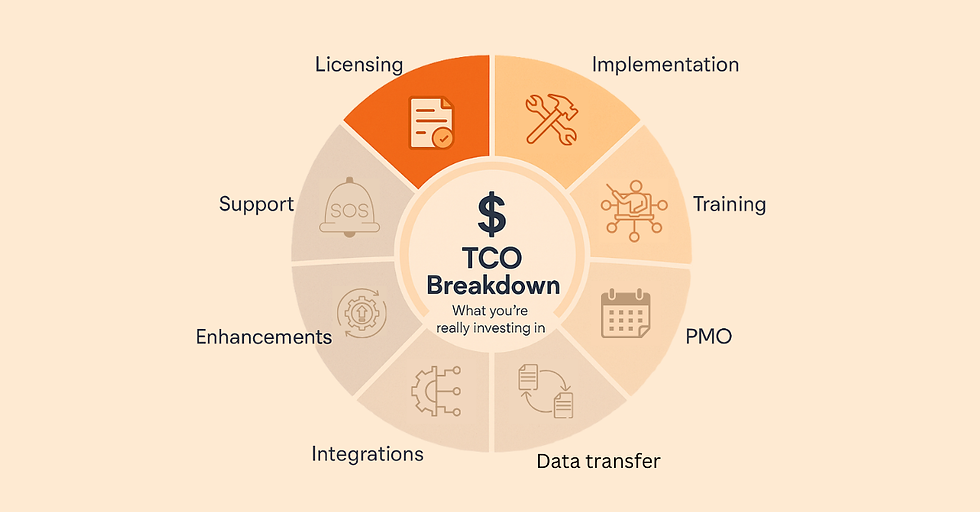
One of the biggest reasons HRIS initiatives break down? Underestimating the real investment, not just in dollars, but in time, change, and internal capacity. A complete financial picture includes:
Initial Costs (What You'll See in the Proposal)
✔ Software Licensing - Varies based on employee count or module access.
✔ Implementation - Ranges from $50K to $600K depending on business size, complexity, and scope.
✔ Training - Budget $100K–$150K for enterprise-level enablement.
✔ Project Management - Typically $150K–$200K across HR, IT, and functional leaders.
Ongoing Costs (What You'll Feel Every Year)
Maintenance & Support (18–22%)
System updates & regulatory adjustments
Training for new features
Integration maintenance
API or data transfer fees
And then, the optional but necessary line item:
✔ Contingency (10–15%) - Because every implementation reveals unknowns.
Organizations that budget realistically experience significantly fewer delays and escalations.
At Principal Group, our rule of thumb is simple:
“A strong business case shapes expectations. A complete business case secures alignment.”
STEP 3: Understanding Today’s HRIS Market (Without Getting Lost in It)
The HRIS landscape is evolving so quickly that choosing based on “past reputation” is no longer enough.

Here are the macro trends reshaping vendor selection:
Trend 1: Cloud is the new standard
95%+ of new HRIS implementations are now SaaS. This means:
Faster deployments
Lower IT dependency
Better security
Continuous updates
Trend 2: AI is no longer optional
Across leading platforms, AI now drives:
Resume screening
Skill mapping
Retention predictions
Compliance alerts
Smart workflows
AI isn’t replacing HR, it’s augmenting it.
Trend 3: Mobile-first expectations
76% of employees expect mobile access to:
Pay
PTO
Benefits
Schedules
Approvals
If your system isn’t mobile-first, adoption will suffer, loudly.
Trend 4: Employee Experience is now a top priority
Post-pandemic, UX matters more than features. Employees will not adopt systems that feel outdated.

Trend 5: Each vendor now has a clear “lane”
You’re not picking a system. You’re picking a philosophy.
Whether enterprise-grade, mid-market, or small-business focused, each vendor has a worldview built into its architecture.
Once you know your organization's lane, your shortlist becomes clearer overnight.
STEP 4: Preparing Internally (Where Most Organizations Fail)
This is the step everyone skips, and it’s the reason most implementations go sideways.

Before you evaluate vendors, you need:
1. Non-Negotiables (Your Deal-Breakers)
These include:
Must-have functionality
Budget range
Timeline constraints
Integration requirements
Global or compliance needs
Payroll complexity
Document your deal-breakers. Otherwise, vendors will sell you their strengths, not your priorities.
2. A Clear Pain-Point Inventory
List your operational challenges with metrics, not anecdotes:
Time spent on manual processes
Error rates
Compliance gaps
Data inconsistencies
Employee frustration
Reporting limitations
A system can’t fix what you can't quantify.
3. The Right Cross-Functional Team
Successful HRIS selections include:
Executive Sponsorship
HR Leadership
IT Stakeholders
Finance Representatives
Payroll Experts
Operational Leaders
Employee Experience voices

Deloitte’s 2024 findings were clear:
92% of successful HRIS projects had active C-suite sponsorship. Only 34% of troubled projects did.
Leadership alignment is not a “nice-to-have.”
It is the differentiator.
4. Data Readiness
The #1 cause of delays isn’t configuration. It’s data.
Organizations that clean their data before migration:
Implement faster
Spend less
Reduce risk
Improve reporting accuracy
Data readiness is one of the most overlooked, but highest ROI, preparation steps.

STEP 5: Evaluating Systems (How to Avoid Demo Theater)
Vendor demos are designed to impress. Your job is to see beyond the script.

Here’s how.
Before the Demo (The Power Moves)
Prepare:
3–5 business-specific scenarios
Sample (anonymized) data
A standardized evaluation scorecard
The exact list of workflows you want to see
Your non-negotiables
This forces vendors into reality, not storytelling.
During the Demo (How to See the Truth)
Score vendors on:
User Interface
Mobile flow
Manager dashboards
Self-service simplicity
Number of clicks
Core HR Functions
Payroll complexity
Time/Attendance nuance
Benefits workflow
Performance management
Technical Capabilities
Integrations
Security
Customization vs configuration
Reporting flexibility
Red Flags That Deserve Your Attention
Be cautious if you see:
🚩 Undefined implementation timelines
🚩 Vague answers
🚩 Overly flexible pricing
🚩 Outdated UI
🚩 Weak compliance posture
🚩 Poor demo performance
🚩 Difficulty providing references
If the demo feels chaotic, the implementation will be worse.
Reference Questions That Reveal Everything

Ask customers:
“What went wrong?”
“What surprised you?”
“What hidden costs emerged?”
“How responsive is support?”
“What broke after go-live?”
“Would you choose this system again?”
References rarely lie, and often save you from disaster.
STEP 6: Making the Final Decision (Where Leaders Get Stuck)
When it comes down to the final decision, most HR teams feel pressure to choose the system with the:
Most features
Flashiest demo
Most convincing salesperson
But the best organizations don’t choose the biggest list.
They choose the best fit.

Principles of a High-Confidence HRIS Decision
✔ Fit beats features - A system that aligns with your workflows will beat one with more modules every time.
✔ Choose for today and tomorrow - Don’t just solve current pain points; anticipate scale, complexity, and future constraints.
✔ Evaluate the relationship, not just the software - Most failures are partnership failures.
✔ Build internal consensus - A system chosen with stakeholders succeeds. A system chosen for stakeholders becomes a point of resistance.
✔ Remember: selection is only Step 1 - Readiness determines implementation success.
The Final Word: HRIS Selection Is a Strategic Decision, Not a Technical One
The HRIS you choose will influence:
How employees experience your company
How managers lead
How quickly HR can execute
How Finance forecasts
How IT integrates
How fast the business can scale
This isn’t a software project. It’s a transformation decision.
At Principal Group, we help organizations select systems with the same precision and strategic clarity we use in implementations, ensuring the technology fits the business, the governance fits the strategy, and the investment pays off long after go-live.
Because the goal isn’t just to choose a system.
It’s to choose a system that will work the way your business works.


Comments